How to calculate how much concrete you need
Concrete is measured by volume, so the math is area × thickness. Measure length and width in feet, convert the thickness from inches to feet (divide by 12), and multiply for cubic feet. Divide by 27 for cubic yards.
- Cubic feet = length (ft) × width (ft) × thickness (ft)
- Cubic yards = cubic feet ÷ 27
- 80-lb bags = cubic feet ÷ 0.6, rounded up
- 60-lb bags = cubic feet ÷ 0.45, rounded up
Always add a waste factor — about 10% — to cover spillage, uneven subgrade, and over-excavation. Concrete is unforgiving; running short mid-pour is far worse than having a little extra.
Concrete will crack — here's how to control where
Concrete cracking isn't an if, it's a where. As it cures and the ground shifts, a slab wants to crack — and with no plan, it cracks in jagged lines right across your new pad. The fix is control joints: tooled or sawn grooves that tell the slab where to crack, in clean straight lines you'll barely notice.
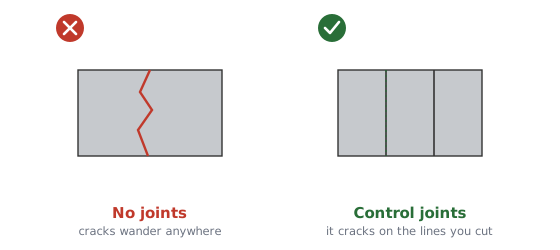
Cut them about every 8 to 10 feet, roughly a quarter of the slab's depth. Get your slab volume right here first, then plan your joints before the pour.
Pro move: order a little extra — you can't pause a pour to run for more, and the truck won't wait.
How thick should a concrete slab be?
| Use | Typical thickness |
|---|---|
| Walkway or patio | 4 inches |
| Driveway (cars) | 4 inches |
| Driveway (heavy vehicles) | 5–6 inches |
| Garage or shed floor | 4–6 inches |
Local code and soil conditions can call for more. Check your requirements before you form and pour.
When to use bags vs. ready-mix?
Bagged concrete is convenient for small jobs — posts, small pads, repairs. But the bags add up fast: a single cubic yard is roughly 45 bags of 80-lb mix. Once you need more than about a half-yard, ordering ready-mix delivered by the truck is usually cheaper and far less work.
Concrete calculator FAQ
- How many bags of concrete in a cubic yard?
- About 45 bags of 80-lb mix, or 60 bags of 60-lb mix, since a yard is 27 cubic feet. That's a lot of mixing — order ready-mix for anything that size.
- Does this calculate footings too?
- Yes. Enter the footing's length, width and depth the same way. For round piers, this rectangular estimate runs a little high, which gives you a safe margin.
- Why add waste?
- Subgrade is never perfectly level, forms flex, and some concrete is always lost to spillage. A 10% allowance keeps you from coming up short.